7:15 AM | *Geminid meteor shower peaks on Friday night, but the weather may not cooperate*
Paul Dorian
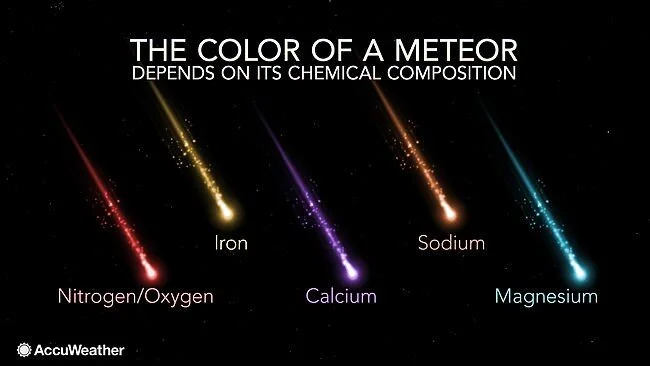
The color of a meteor depends on its chemical composition; courtesy AccuWeather
Overview
It is time once again for the annual Geminid meteor shower – often the best meteor shower of the year - which peaks on December 13-14 (Friday-Saturday) right on the heels of the full moon (Thursday, December 12). Fortunately, Geminids are rich in fireballs and many of them may be seen in spite of lunar interference. The Earth is now entering a stream of debris from the “rock comet” officially named “3200 Phaethon”. If viewing conditions are favorable - and that is a big question mark - then there could be as many as 120 meteors per hour.
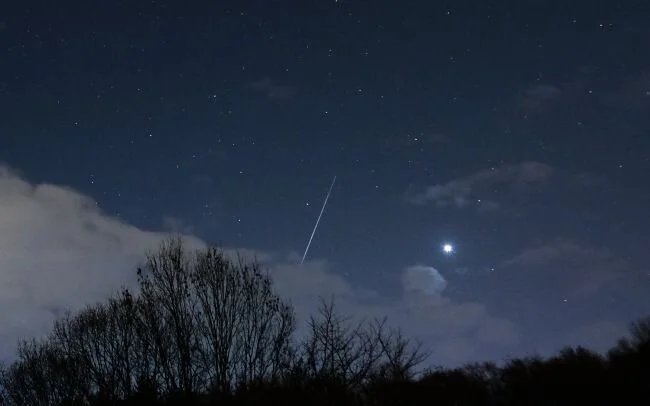
This image is from the Geminid meteor shower of December 2018 and was taken over Saltburn-by-the-Sea in the United Kingdom; credit Getty/Ian Forsyth
Details
Most meteor showers are caused by comets, but the Geminid meteor shower is somewhat mysterious in that “3200 Phaethon” is kind of a strange rocky object that was discovered in 1983. In fact, many references to “3200 Phaethon” simply use the term “asteroid” as a way of description, but others use the phrase “rocky comet” which is a new kind of object cited by some astronomers. They define a “rocky comet” as essentially, an asteroid that comes very close to the sun--so close that solar heating scorches dusty debris right off its rocky surface. Rock comets could thus grow comet-like tails made of debris that produce meteor showers on Earth.
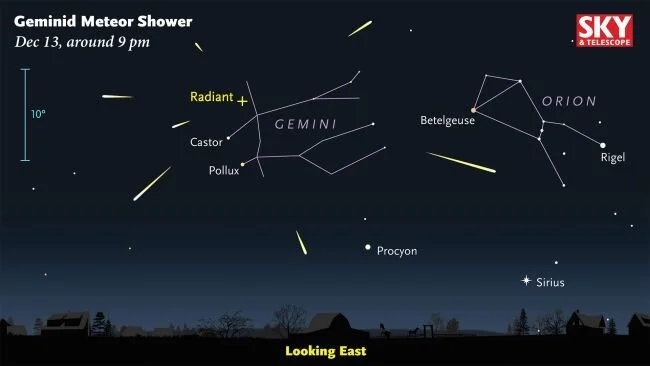
Geminid meteors appear to diverge from a single spot in the sky, called the radiant, located in the constellation Gemini. But you'll see as many as possible if you lean back and take in the whole sky — they can appear anywhere across the sky, traveling away from that point. (Image credit: Sky & Telescope/Gregg Dinderman)
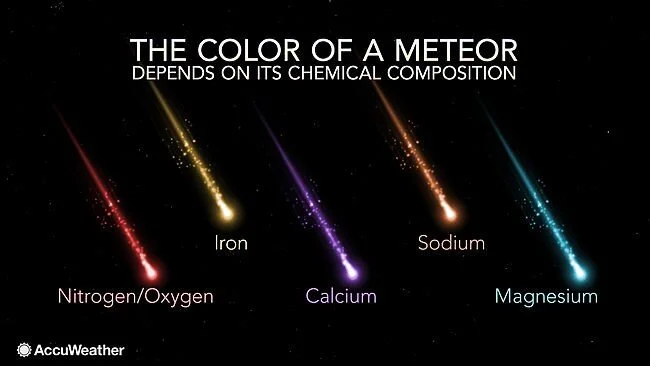
Earth runs into this stream of debris from “3200 Phaethon” every year in mid-December causing meteors to fly from the constellation Gemini – hence the name Geminids. The Geminid meteor shower does not only produce numerous shooting stars, but it is also known to produce some unusual colors as they streak across the sky. The color of light that the meteors produce depends on their chemical composition. Different chemicals produce different colors as they burn up while moving through the Earth’s atmosphere (above). The best time to view should be in the wee hours of early Saturday morning – depending, of course, on cloud cover.
The Geminid meteor shower is nearly 200 years old, according to known records — the first recorded observation was in 1833 from a riverboat on the Mississippi River — and is still going strong. In fact, it's growing stronger. That's because Jupiter's gravity has tugged the stream of particles from the shower's source, the asteroid 3200 Phaethon, closer to Earth over the centuries.
Stay tuned…the weather does not look like it will cooperate, but there are still a couple of days to go before the event.
Meteorologist Paul Dorian
Perspecta, Inc.
perspectaweather.com