*Weather is likely to have minimal impact on the 2026 World Series between Milwaukee (retractable roof) and Tampa Bay (permanent roof), but it has played a critical role in many recent games*
Paul Dorian
Overview
The 2026 World Series begins on Friday night, October 23rd, in Milwaukee, Wisconsin between the hometown Brewers and the Tampa Bay Rays. Neither team has ever won The Fall Classic with the Brewers losing once in 1982 to the St. Louis Cardinals, and the Rays losing twice in 2020 to the Los Angeles Dodgers and 2008 to the Philadelphia Phillies. Note – the Milwaukee Braves did win one championship in their tenure during the 1957 season by beating the New York Yankees and that franchise ultimately moved to Atlanta after the 1965 season.
One interesting facet of this World Series is that the Milwaukee Brewers play in a stadium with a retractable roof and the Tampa Bay Rays play in the only big-league stadium that features a permanent roof. As a result, the weather is likely be a minimal factor during the World Series, which cannot be said for numerous games in recent history where the weather ranged from biting cold to extreme heat and included snow or rain on many occasions.
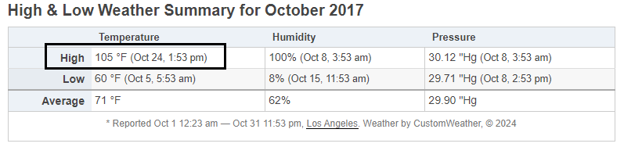
The hottest day of October in Los Angeles during 2017 turned out to be Tuesday, the 24th which is when the 2017 World Series got underway. The high temperature on that afternoon was 105 degrees, and the game time temperature of 103 degrees was the hottest of any World Series game in recent history.
Notable examples of World Series games in recent history impacted by weather
1) 2017 Houston Astros vs Los Angeles Dodgers
The hottest World Series game of recent history took place in Los Angeles, California on October 24th in 2017. In that World Series, Game 1 between the Houston Astros and LA Dodgers featured a game-time temperature of 103 degrees. That first game was won by the Dodgers by the score of 3-1 with all runs knocked in by the three home runs that were hit by both teams. Houston went on to win the 2017 World Series in seven games, but no other game was as hot as Game 1 which featured triple-digit heat. In fact, by the time the Series returned to Los Angeles for games 6 and 7, game time temperatures were in the much more comfortable upper 60’s.
2) 2008 Philadelphia Phillies vs Tampa Bay Rays
Perhaps the most memorable World Series game in recent history with respect to overall weather conditions was Game 5 of the 2008 World Series between the Philadelphia Phillies and the Tampa Bay Rays. That game began on October 27th in 2008 with a starting time temperature of 47 degrees and rain was falling. The rain intensified as the game progressed and was ultimately suspended in the 6th inning – the only World Series game ever to be suspended. The game could not be resumed on the next day as a powerful early season nor’easter continued to pound away on the Philadelphia metro region with cold, steady rain and even several inches of snow fell in nearby Bucks County. Finally, two days after the game began, Game 5 resumed on a cold night in Philly with first-pitch temperatures at 44 degrees along with a gusty northwest wind on the back side of a departing coastal storm and the Phillies went on to clinch their second World Series title ever.
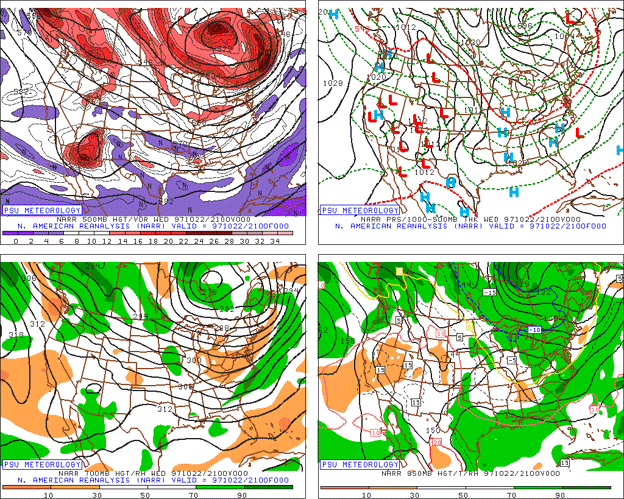
Weather maps are shown here from the night of October 22nd in 1997 which featured Game 4 of the World Series played in Cleveland, Ohio. An unusually strong upper-level trough of low pressure was positioned just to the north of the Great Lakes (upper left) and contributed to very cold conditions for Game 4 with snow flurries throughout the contest. Maps courtesy Penn State eWall (surface - upper right, 500 mb - upper left, 700 mb - lower left, 850 mb - lower right).
3) 1997 Cleveland Indians vs Florida Marlins
In perhaps the coldest World Series games ever - and the records are sketchy pre-1970’s as Major League Baseball did not track weather records – one of the most memorable contests was Game 4 of the 1997 World Series in Cleveland, Ohio between the Indians (now Guardians) and the Florida (now Miami) Marlins. The first two games of that World Series were played in Miami, Florida where temperatures were in the high 80’s. The games then shifted to Cleveland for Games 3, 4 and 5 and the weather was dramatically different than in Florida. Indeed, the first-pitch temperature for Game 4 on October 22nd, 1997, which was won by Cleveland was 35 degrees and a wind chill in the teens. In fact, snow flurries were falling at the onset of Game 4 and continued throughout the contest and ice patches formed in some areas on the infield. The Florida Marlins eventually won the 1997 World Series with an extra-inning Game 7 victory played in balmy Miami, Florida (game time temperature of 80 degrees).
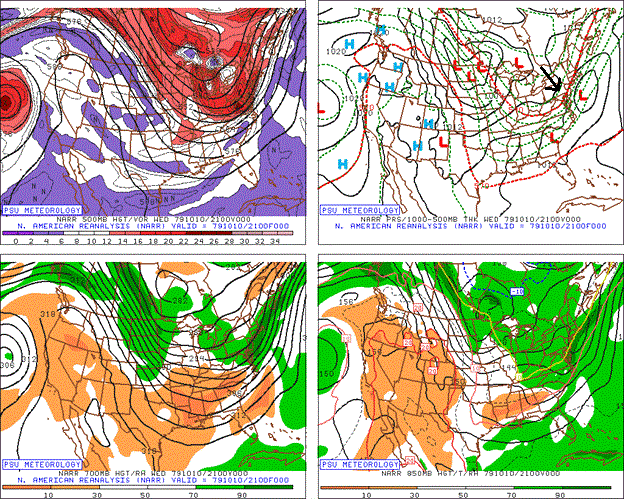
Weather maps are shown here from the evening of October 10th, 1979, which was the day the World Series began in Baltimore, Maryland between the Orioles and the Pittsburgh Pirates. Low pressure along the Mid-Atlantic coastline not only generated some rainfall for Game 1, but it funneled in very chilly air from the north as well and the combination of the cold and wet conditions played a role in the overall sloppy performance. Maps courtesy Penn State eWall (surface - upper right, 500 mb - upper left, 700 mb - lower left, 850 mb - lower right).
4) 1979 Baltimore Orioles vs Pittsburgh Pirates
The second coldest game in recent history was the first game of the 1979 World Series in Baltimore, Maryland between the Orioles and Pittsburgh Pirates. This game took place on October 10th, 1979, with first-pitch temperatures right around the 40-degree mark along with a steady, chilly rainfall which no doubt factored into the six total errors, three committed by each team. In fact, Game 1, which was won by Baltimore was originally scheduled for Tuesday, October 9th, but was postponed due to a wintry mix of rain and snow. Back in those days, the World Series began earlier in the month of October compared to today, but that didn’t prevent very cold weather from impacting the beginning of this Fall Classic. The Pirates ended up winning the 1979 World Series in 7 games by winning three games in a row after trailing in the series three games to one.
Meteorologist Paul Dorian
Arcfield
arcfieldweather.com