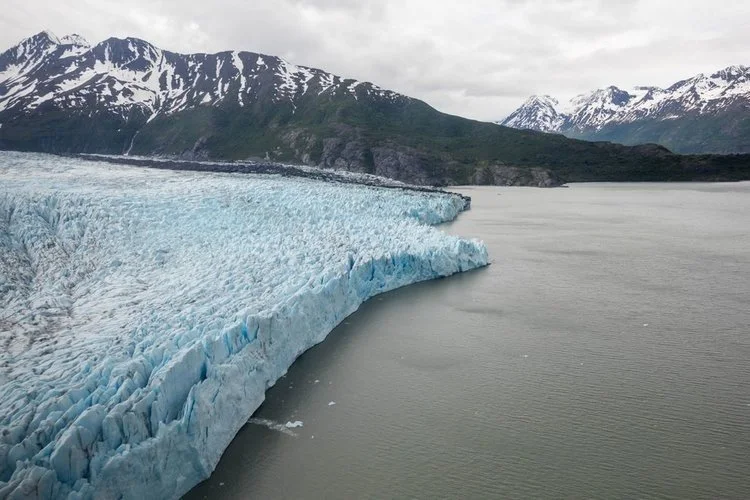
*Operation Colony Glacier brings full identification for all 52 fallen service members lost in 1952 military plane crash in Alaska...it was a race against time*
Paul Dorian
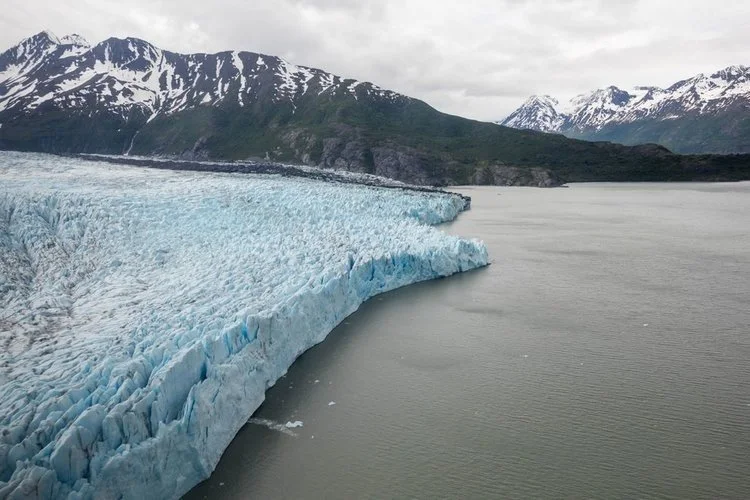
Colony Glacier as seen through the window of an Alaska Army National Guard UH-60 Black Hawk on Saturday, June 16, 2018 (Loren Holmes/Anchorage Daily News)
Overview
For 60 years, the Colony Glacier of Alaska hid the remains of 52 servicemen in a frozen grave after an Air Force plane crashed into the side of a mountain during bad weather. The military transport plane was on route to Elmendorf Air Force Base near Anchorage just five days before Thanksgiving Day when it crashed into 9,629-foot Mount Gannett on November 22nd, 1952, in the Chugach Mountain Range about 40 miles east of Anchorage. The wreckage of the plane and the remains of the 52 servicemen slid into the glacier next to the mountain. Recovery efforts never got into high gear that year as Alaska’s unforgiving winter came on quickly and by later the following year, the glacier and new deep snowpack had claimed the aircraft and its passengers.
It was not until 60 years later in June 2012 that the wreckage was spotted by members of the Alaska National Guard UH-60 Black Hawk crew during a routine training mission in the spring melt on the glacier about 14 miles from the original crash site. Since then, crews returned every summer to try to recover the remains and personal effects during a small window of opportunity of about one month when it was relatively safe to do so on the glacier. Finally, after all of these years, the Air Force announced in early 2026 that the remains of all 52 services members lost in the 1952 crash at Colony Glacier, Alaska, have been positively identified. This painstaking effort was a race against time as the relentless north-flowing Colony Glacier advanced relatively quickly pushing the wreckage of the plane and passenger remains towards nearby Inner Lake George - and perhaps lost forever to history.
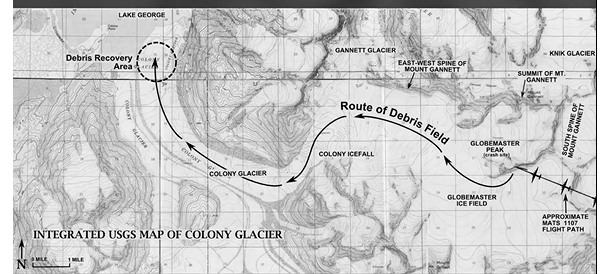
Colony Glacier relentlessly advances towards nearby Inner Lake George and has pushed the debris field several miles during the past 74 years (map courtesy USGS)
The crash in 1952 and the immediate unsuccessful recovery attempts
The Colony Glacier is a sixty square mile mass of ice and snow situated on the south flank of Mount Gannett. The ice fields that feed Colony Glacier are unnamed and make up most of the surface area of the glacier. The terminus of the glacier is in Inner Lake George about 13 miles southwest of Mount Gannett.
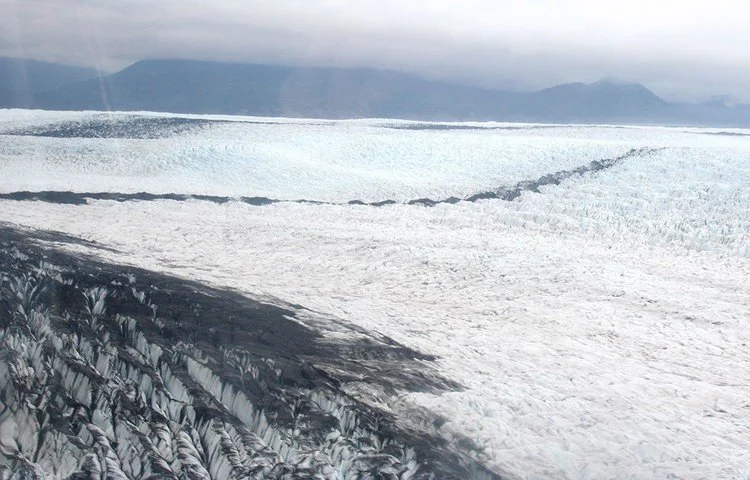
Colony Glacier as seen from a window of a Black Hawk helicopter on Wednesday, June 21, 2017. Courtesy Gary Black/News-Miner
An Air Force C-124A military transport airplane known as the Globemaster was on route to Elmendorf Air Force Base near Anchorage, Alaska on Nov. 22, 1952, with service members from all branches when it crashed into Mount Gannett and slid into an ice field above the Colony Glacier. The plane was miles off course when it crashed on that fateful day due largely to bad weather and thick clouds and rather unreliable instrumentation which was much less sophisticated than today’s technology.
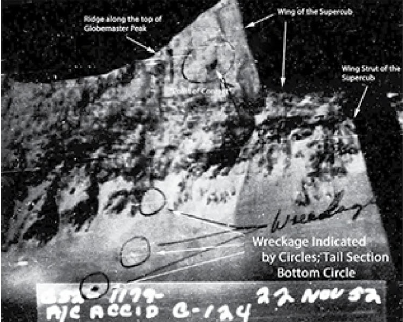
This reproduced image was appended to the official “Report of an Air Force Major Aircraft Accident Involving C-124A No. 51-107A”. The upper circle is annotated “Point of Contact”, the three lower circles are annotated “Wreckage”. The impact point was assumed based on the point where an avalanche seemed to have emanated. The date on the photograph reflects the date of the accident - not the date the picture was taken. The photograph was taken at an altitude of about 9,500 feet looking from a point approximately three to five miles east of the crash site. Courtesy US Air Force; book entitled “Letters from the Globemaster Families: The Lost C-124 of Mount Gannett, Alaska")
The force of the crash and subsequent fuel explosion obliterated the airplane and actually triggered a massive avalanche. The combination of the avalanche and quickly accumulating heavy snowfall greatly inhibited the chances for any successful recovery attempt in the days immediately following the crash. To make matters worse, Alaska was only a territory in 1952 – not to become a state for several more years - and the US Geological Survey (USGS) had not yet even completed a comprehensive set of topographic maps for the area. The Air Force’s second and final recovery attempt took place during the following summer of 1953, but it too was largely unsuccessful with only some mail visible on the snow top and recovered. In fact, by early August of 1953 when there was an early season snowstorm, it was estimated that the plane’s wreckage and the remains of the 52 servicemen had already been buried under 50 feet of snow and feared to be lost forever.
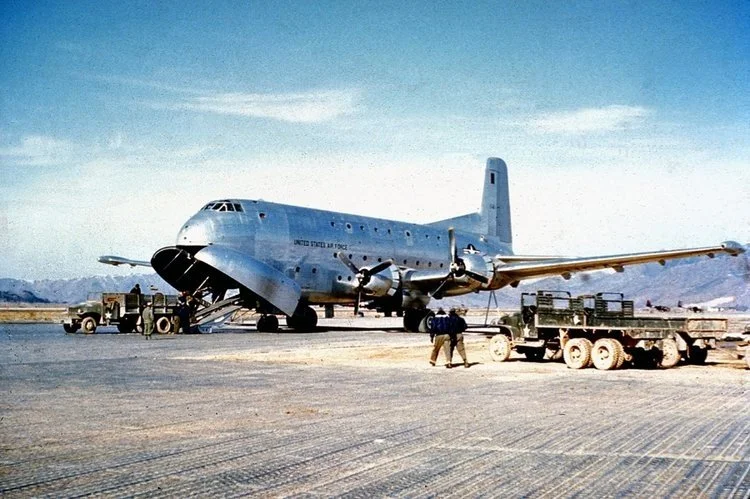
A C-124A Globemaster is unloaded on an airfield in Korea during the Korean War. (Credit U.S. Air Force)
Wreckage is sighted 60 years later, and new recovery efforts began
On June 9, 2012, debris (large yellow canister) was spotted by an Alaska Army National Guard Black Hawk helicopter pilot on a routine training flight near the terminus of Colony Glacier depositing into Inner Lake George. At first, officials thought the debris was from a plane crash that hadn't yet been reported, but a ground recovery mission confirmed that it was actually from the Globemaster. Over the six decades since the 1952 plane crash, the wreckage had traveled about 14 miles down Colony Glacier (averaging about a meter per day) pushing to less than about 2000 yards from the toe or leading edge of the glacier which empties into Inner Lake George.
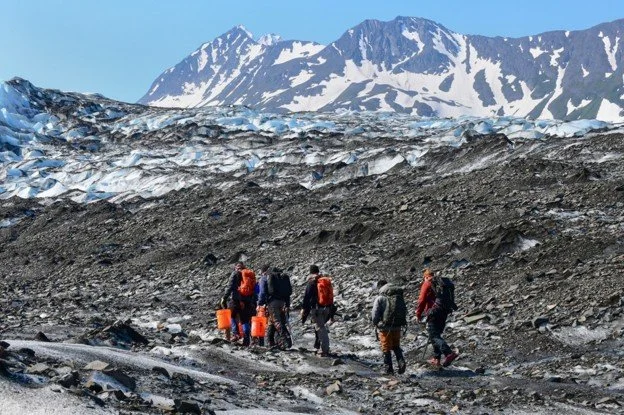
Military and civilian searchers hike across Colony Glacier June 13, 2022, to reach the remnants of a military plane crash. The team is working to recover the remains of 52 passengers and crew members, and wreckage of an Air Force C-124 Globemaster aircraft that crashed Nov. 22, 1952, near Mount Gannett, Alaska. Soldiers assigned to the Alaska Army National Guard discovered the debris on June 10, 2012, during a routine Black Hawk helicopter training mission on Colony Glacier nearly 14 miles from where the plane first crashed. (Army photo/John Pennell)
Since the discovery in 2012, the military returned each June to identify any new areas of wreckage exposed by the constantly moving glacier. For the past few years, soldiers from the 11th Airborne Division, the Arctic Angels, joined the efforts and helped scour the debris field on the ever-changing, constantly moving glacier while providing mountaineering experience to help ensure the searcher’s safety. The soldiers agreed their mission on Colony Glacier is the embodiment of the Army’s “I will never leave a fallen comrade” oath in the soldier’s creed.
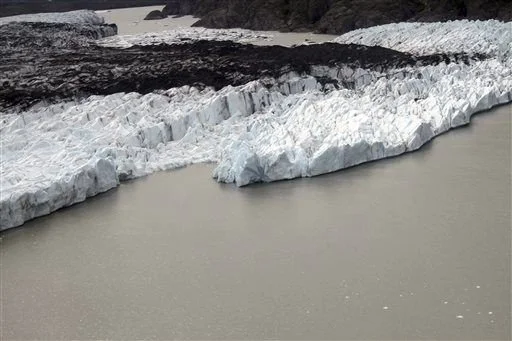
This photo was taken in June 2015 and shows the toe or leading edge of Colony Glacier and Inner Lake George. The somber effort to recover the human remains from 52 service members who died when their airplane smashed into an Alaskan mountain continued each summer since the re-discovery in June 2012 (Photo courtesy AP/Mark Thiessen).
The window to work safely on the Colony Glacier had to be perfectly sandwiched between the snowpack clearing in early June and warming temperatures by mid-July that could cause an increase in large, sudden and dangerous glacial cracks called crevasses opening across the recovery area. Work typically started early to mid-June and wrapped up for the year by early July. In this roughly one-month window, painstaking work was undertaken by a small crew assembled from within Alaska military organizations. They carefully hacked the glacier with ice picks and combed it with trowels, often on their knees, looking for the tiniest pieces of debris. They found such things as uniforms, dog tags, wallets, lighters, three gold wedding rings and bone fragments sometimes as small as a fingernail.
All of the painstaking efforts since 2012 have paid off as all 52 members aboard the C-124 have been positively identified. With the identification process now complete, the Air Force is assessing whether to formally close Operation Colony Glacier, as the recovery site no longer shows evidence of additional remains or material emerging from the glacier. Operation Colony Glacier stands as a testament to the War Department's unwavering commitment to the fallen and their families, ensuring that all who serve are accounted for and honored.
[Spectacular close-up Video of Colony Glacier and Inner Lake George].
Meteorologist Paul Dorian
Arcfield
arcfieldweather.com