**Keeping a close eye on the sun**
Paul Dorian
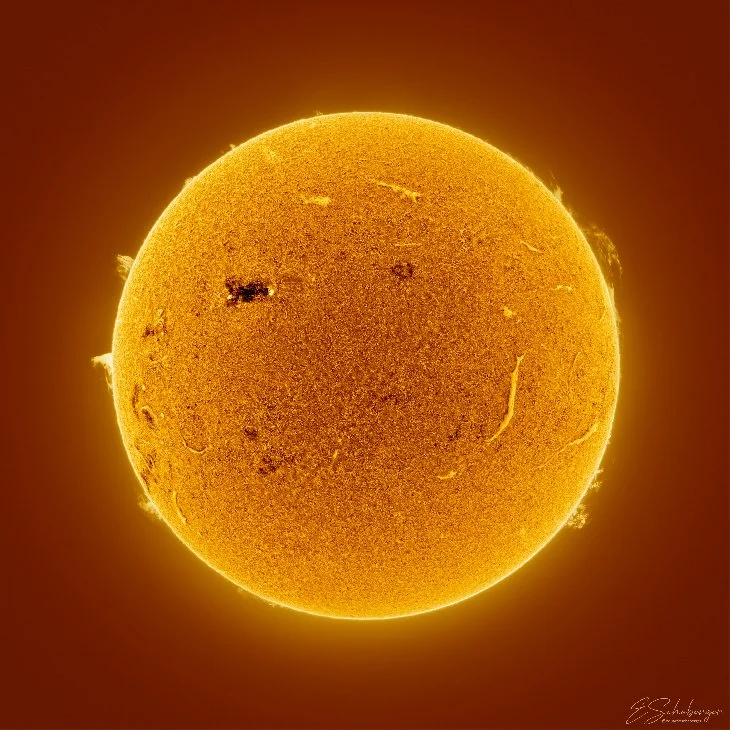
This picture of the sun was taken by Eduardo Schaberger Poupeau at noon on Monday, February 2nd in Rafaela, Argentina (image courtesy spaceweather.com)
Overview
Solar cycle 25 has potentially passed through its maximum phase during the latter part of 2025 (don’t really know for sure until after the fact), but it continues to be very active time with lots of sunspot activity in recent weeks. One particular sunspot region known officially as AR4366 has grown rapidly in recent days and it has become the most active sunspot of solar cycle 25. This sunspot region is now more than ten times wider than Earth and is moving into a position that more directly faces our planet. The rapid growth of AR4366 has made the sunspot region unstable and it has indeed unleashed dozens of solar flares during the past few days. More explosions are quite likely and - given its movement in the near-term - all eyes are closely monitoring the situation.
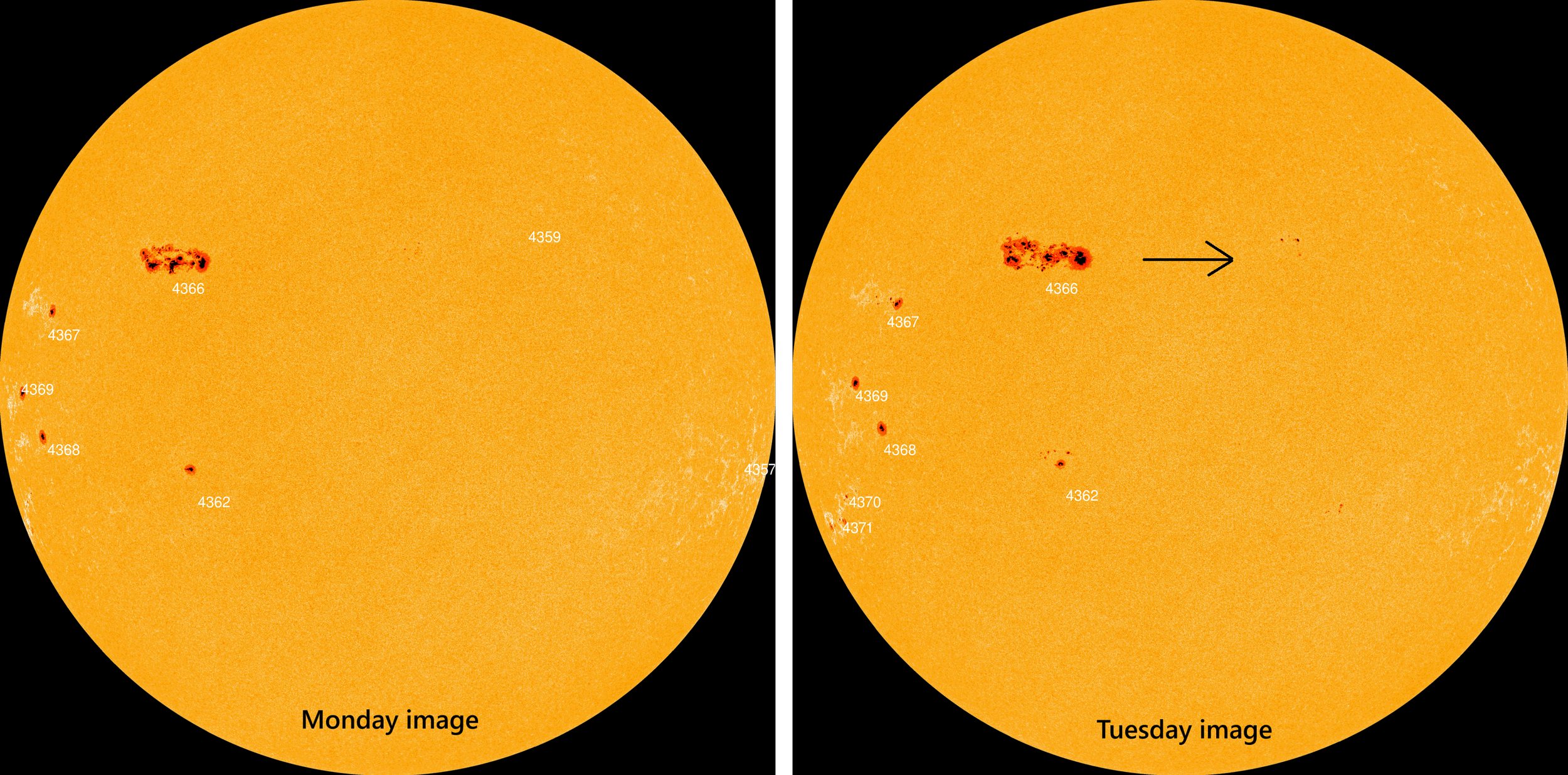
Active sunspot region known as AR4366 is rotating into a position that directly faces the Earth…being closely monitored for any signs of a solar storm. Images courtesy spaceweather.com, NASA/SDO
Details
Giant sunspot AR4366 has been called a “solar flare factory” by solar scientists and is now rotating into an Earth-facing position, raising the chance that near-term eruptions could launch coronal mass ejections (CMEs) directly toward our planet. It has already produced 23 M-class solar flares and 4 X-class flares during the past few days with the most intense taking place on Sunday, February 1st, with an X-8.1 classification. Early analysis of the CME linked to the X8.3 eruption suggests that most of the solar material is likely to pass north and east of Earth, with only a possible glancing blow expected around Feb. 5, according to NOAA's Space Weather Prediction Center. It is possible that more eruptions are still to come given the highly active nature of AR4366 as it continues to rotate around the sun.
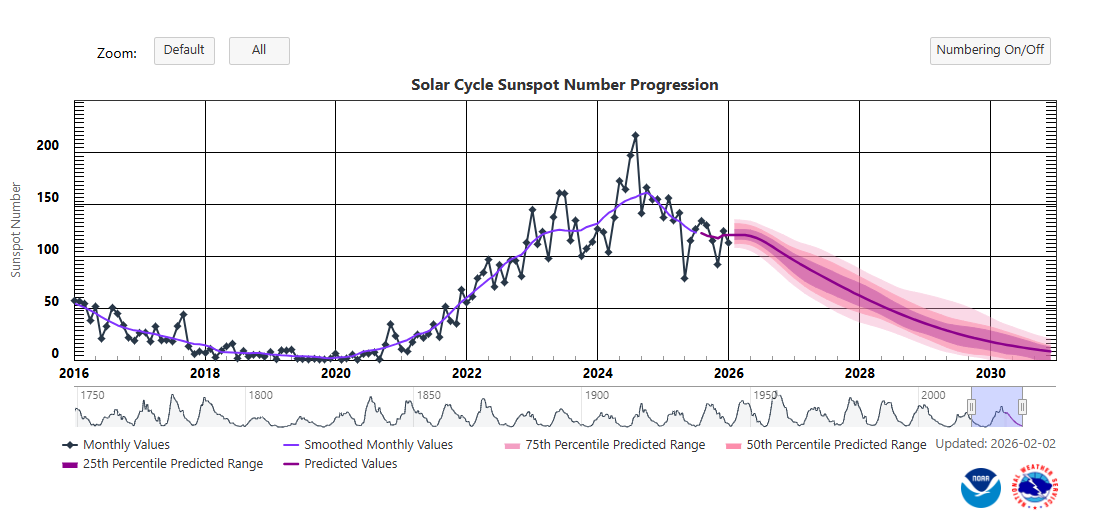
Solar cycle 25 has potentially passed through its maximum phase during 2025 and continues to exhibit high amounts of activity with respect to the number of sunspots. Plot courtesy NOAA
Solar flares are powerful explosions from the sun that emit intense bursts of electromagnetic radiation. They are ranked in ascending strength from A, B, C and M up to X, with each letter representing a tenfold increase in intensity. X-class flares are the strongest eruptions and the number following the X indicates how powerful the event is. Sunday’s flare was measured at X8.3, putting it high in the upper tier of solar outbursts. Solar Cycle 25 is proving stronger than initially predicted with some intense and unexpected solar activity.
Meteorologist Paul Dorian
Arcfield
arcfieldweather.com