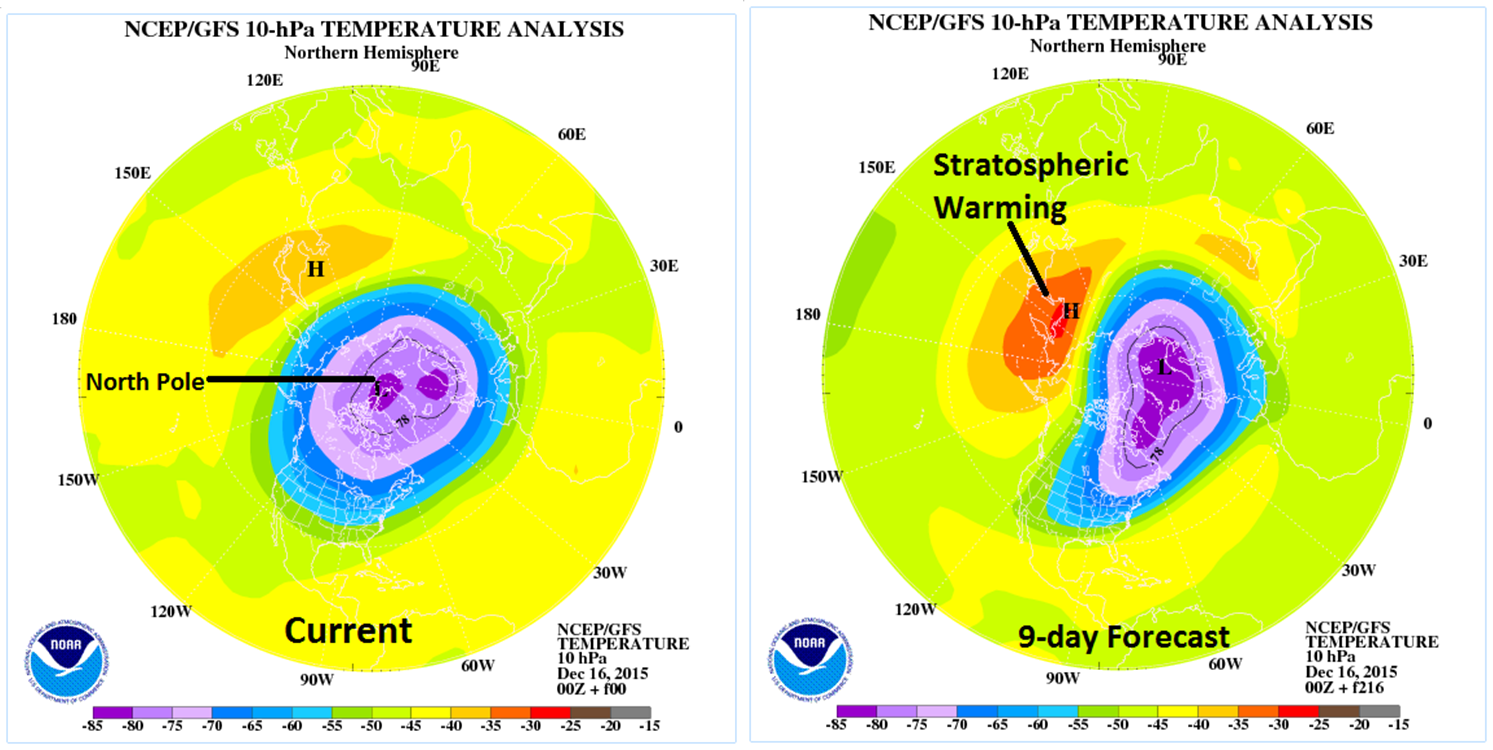
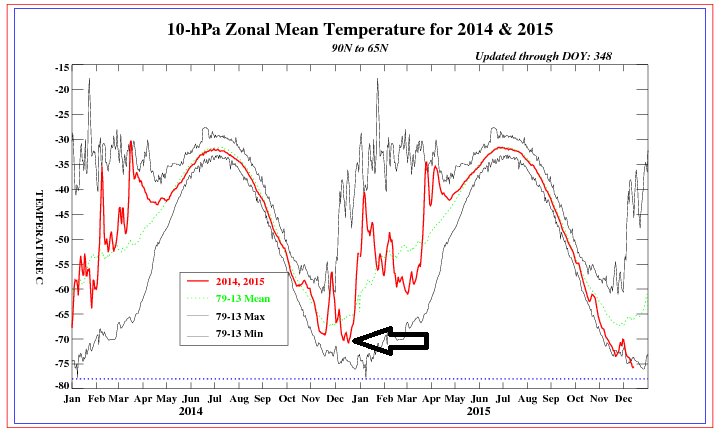
We’ve talked for several days about several signals (“teleconnections”, stratospheric warming, MJO) that pointed to an important change coming in the overall weather pattern that would bring us much closer-to-normal temperatures by the beginning of the New Year and more sustained cold air outbreaks during the month of January and perhaps beyond. There is no change at all in that outlook. In fact, there are even signs for below-normal cold air outbreaks in the Mid-Atlantic region during the next few weeks beginning with an Arctic blast set to arrive for Monday and Tuesday of next week. Furthermore, now that the colder pattern seems to be settling into the Mid-Atlantic region, it is time to monitor potential threats for snow and indeed the period about 10-15 days from now looks quite ripe with storminess potential for the Mid-Atlantic region.
Read More
The month of December has been much warmer-than-normal in the Mid-Atlantic region (PHL +13.8°, DCA +11.3°,NYC +13.8°), but there are numerous signs that a significant pattern change is coming which will allow for much more in the way of sustained cold air outbreaks in the area. The first two signals suggesting a pattern change – stratospheric warming and a tropical disturbance known as the Madden Julian Oscillation (MJO) – have been discussed already in recent postings on our “Climate Info” page: http://www.vencoreweather.com/blog?category=Climate%20Info ). Now there are other “teleconnection” signals that also suggest a pattern change is coming to the Mid-Atlantic region for the month of January and perhaps even beyond which will bring far different weather than what we experienced during this potentially record-breaking warm month of December.
Read More
The month of December has been much warmer-than-normal in the Mid-Atlantic region and there are at least two more widespread record-breaking days to come in the near future. Longer term, however, there are signals for an important pattern change in the eastern states as we begin the New Year. One of the signals for a pattern change is connected to a tropical disturbance called the Madden Julian Oscillation (MJO). Its projected changes over the next couple of weeks as depicted by a reliable computer forecast model (Euro) suggest changes are coming here by the beginning of January.
Read More
The month of December has been much warmer-than-normal in the Mid-Atlantic region and there are several warm days still to come during this week and next. Indeed the month of December could turn out to be the warmest ever in much of the region aided in large part by the strong El Nino oceanic cycle in the tropical Pacific Ocean. So far this month temperatures have averaged 10.6°F above normal in Philadelphia, 11.3°F above normal in Central Park, NY, and 7.6°F above normal in Washington, D.C (Reagan National Airport). There are signs; however, for an important change in the overall weather pattern that is likely to occur around the New Year’s Day holiday period and it should bring quite a change in temperatures to the eastern states from well above normal to much closer-to-normal.
Read More
Despite an upcoming cold weekend, our recent warm weather pattern will re-emerge next week and it’ll likely continue right past Christmas Day. The month of December so far has been well above normal in the Mid-Atlantic region (+10.8 at PHL, +8.1 at DCA, +11.2 at Central Park) and there will be a setback this weekend, but the eastern US will warm up significantly next week while the western states cool down dramatically. In fact, record warmth is likely in many areas east of the Mississippi River by the middle of next week.
Read More
The first week of December was quite mild in the I-95 corridor with temperatures averaging 6.5 degrees above normal in Philadelphia, 6.2 degrees above normal at Central Park in New York and 3.1 degrees above normal at Reagan National Airport in Washington, D.C. This week also looks relatively mild with high temperatures likely reaching or even exceeding the 60 degree mark in parts of the region by this weekend. Looking ahead, however, there are signs that the upper atmosphere pattern will change to allow for more normal cold to arrive as we progress through the second half of December.
Read More
Mount Etna is the largest volcano in Europe and one of the most active volcanoes in the world. On Thursday morning, December 3rd, southern Italy woke up to see an eruption after two years of silence. Scientists say it was the most violent eruption from the volcano in the past two decades. The intense eruption exploded from Etna’s Voragine crater with ash reaching as high as 10,000 feet into the atmosphere and a fountain of lava as high as 5000 feet. High level winds pushed ash over villages in Sicily and other portions of southern Italy. Volcanic lightning was also seen above Mt Etna on Thursday during the eruption period which lasted less than an hour. The Voragine crater was formed inside of the central crater in 1945 and is among three other craters in the volcano: Bocca Nuova, the crater of the Northeast, and the crater of the Southeast which is said to be the most active one.
Read More
More good news this year for the nation on the extreme weather front as it has been another down year in terms of hurricanes and tornadoes. The Atlantic Basin hurricane season officially ends tomorrow, December 1st, and it is quite likely safe to say that this will be another below-normal year in the US for land falling tropical storm activity. In fact, the US has not been struck by a major hurricane (category 3, 4 or 5) in slightly more than ten years and this is the longest drought of that kind since record-keeping began in 1851. In addition, 2015 is turning out to be another below-normal year for tornadoes across the nation and this too continues a trend that is a decade in the making.
Read More