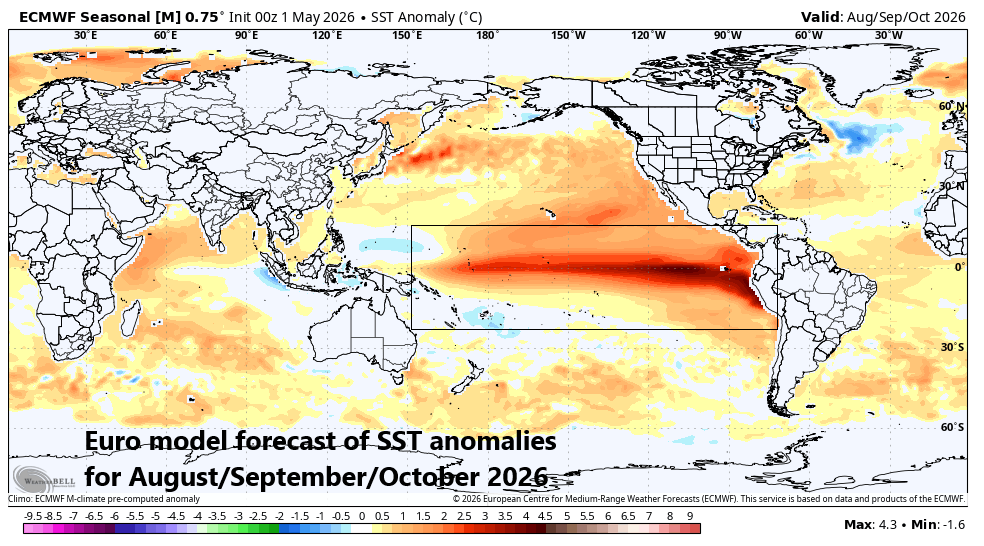
**El Nino on the way...could be one of the strongest in the last 50 years...big (inhibiting) impact likely on the Atlantic Basin tropical season...potential effects next winter...historical context**
Paul Dorian
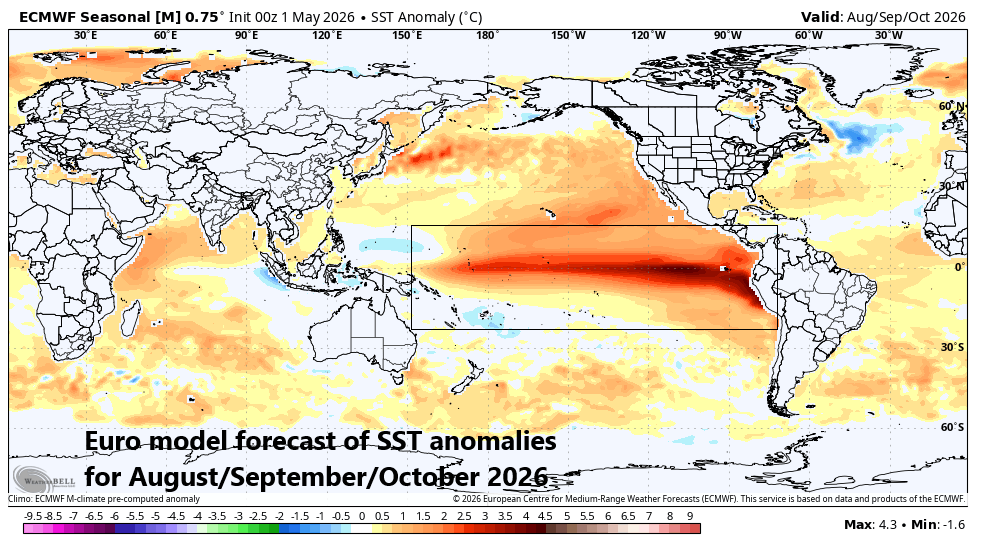
The most recent run of the Euro model features very strong El Nino conditions in the tropical Pacific in the August/September/October time period which would have big implications on the upcoming tropical season in the Atlantic Basin (see 2026 Tropical Outlook). Plot courtesy ECMWF, Weather Bell Analytics (Meteorologist Joe Bastardi, X)
Overview
As noted in the 2026 Tropical Outlook, El Nino is going to be a major player with respect to the upcoming tropical season in the Atlantic Basin and signs are increasingly pointing to one of the strongest episodes in the last 50 years. The most powerful El Nino events in recent history took place in 1982-1983, 1997-1998, and during 2015-2016, and this upcoming occurrence could rival all of them in terms of its magnitude. Not only have surface water temperatures climbed dramatically in recent days across the tropical Pacific Ocean, but some very warm water relative-to-normal lurks just beneath the surface…and it is “bubbling” up to the top. El Nino will have worldwide impacts during the summer and fall seasons and likely be a big inhibiting factor to the Atlantic Basin tropical season due to increased subsidence and wind shear (hostile conditions for tropical systems). Should El Nino continue into the first part of 2027 - and odds are quite good from this vantage point - it could have big implications on the winter season across the continental US...something we’ll monitor in the months to come.
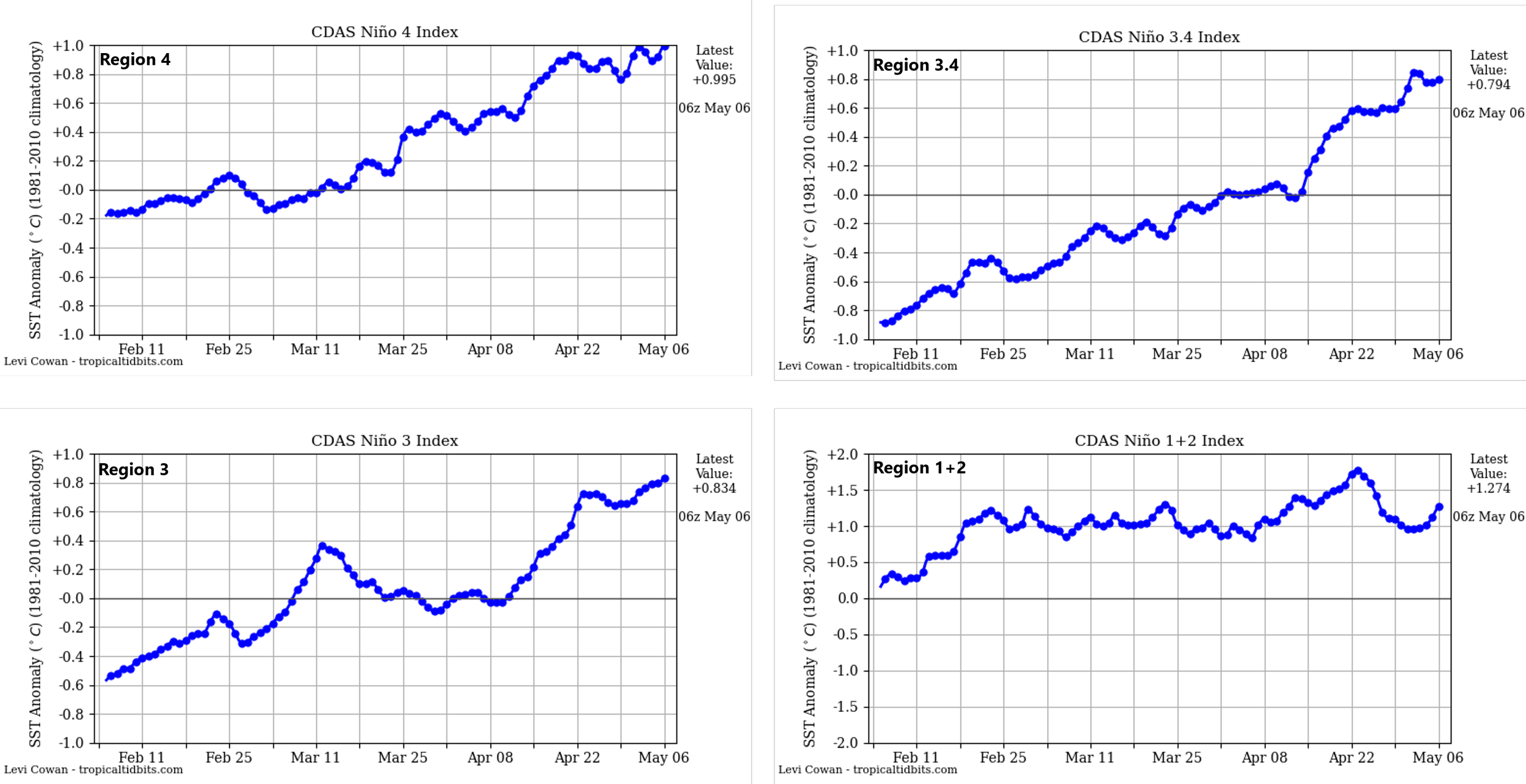
Water temperatures have climbed dramatically in recent days across all four “regions” of the tropical Pacific Ocean as El Nino conditions become increasingly established. Plots courtesy NOAA, tropicaltidbits.com
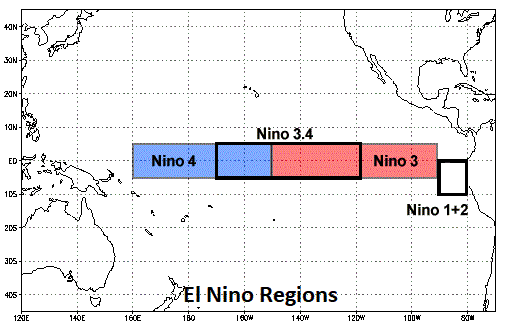
The El Nino region of the Pacific Ocean is divided into sub-sections by meteorologists as outlined on this map with “Nino 3.4” region (5 °N-5°S, 120°W-170°W, boxed region in middle) in the central part of the equatorial Pacific Ocean and “Nino 1+2” (boxed region at right) positioned near the west coast of South America.
The development of El Nino
Meteorologists separate the world’s largest ocean into four regions as a way of better pinpointing specific areas in the tropical Pacific and all have been experiencing rapid water temperature rises in recent weeks. In fact, all four regions now feature water temperatures that are well above-normal with the warmest relative-to-normal being the far eastern region known as “1+2” that sits just off the west coast of South America.
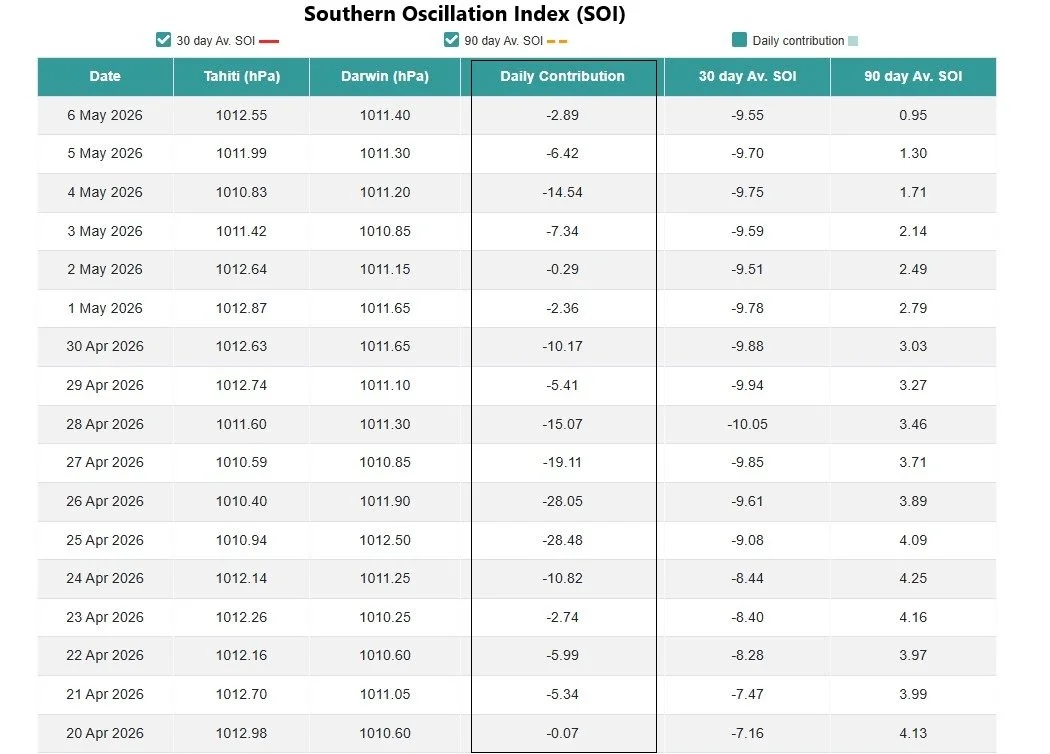
A teleconnection index known as the Southern Oscillation Index or SOI is showing signs of a developing El Nino in the tropical Pacific. This standardized index is calculated by using pressure differences between Darwin, Australia and Tahiti which is located about 5300 miles to the east. ) If the SOI is in “negative” territory for a sustained period of time, El Nino conditions will usually be detected (i.e., above-normal water temperatures). Data courtesy Queensland Government Australia
Meanwhile, deep-sea buoys in the tropical Pacific Ocean are measuring water temperatures that exist far beneath surface level. In fact, these instruments can capture water temperatures on a frequent basis all the way down to 450 meters beneath the surface and what they show is quite amazing. Water temperatures are running at significantly warmer-than-normal levels within the top 200 meters or so below the surface and this warm water is “bubbling” up to the top. The deep-sea buoys in the Pacific TAO (Tropical-Atmosphere Ocean) array operate as part of NOAA’s National Data Buoy Center and have undergone significant upgrades since the original array was completed in 1994. They provide critical “real-time” observations in the monitoring of El Nino (or La Nina) in the world’s largest ocean.
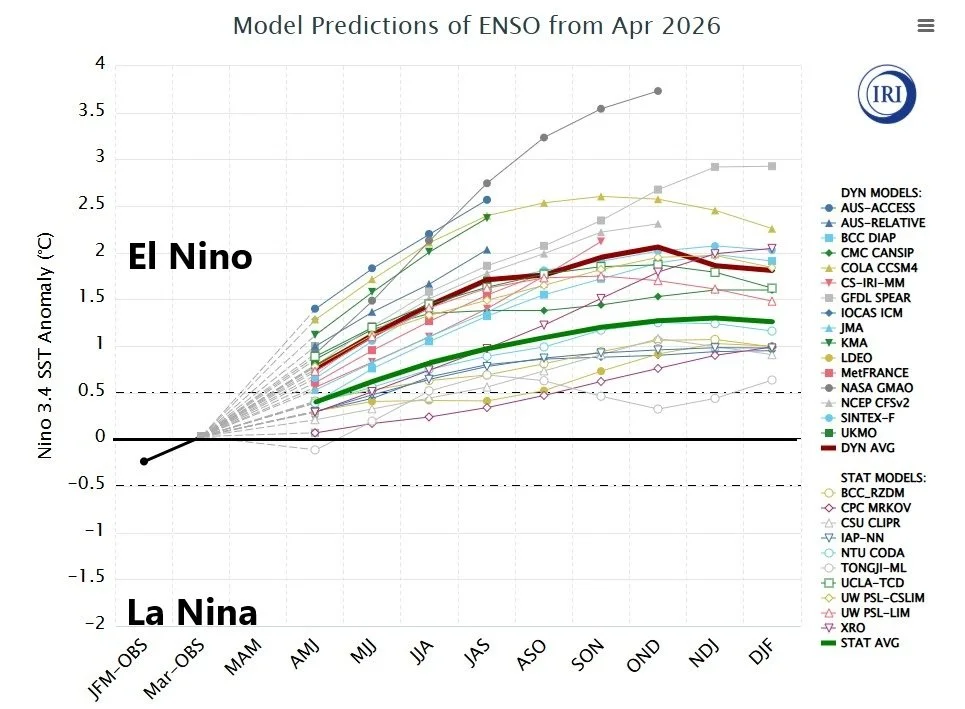
Forecasts of sea surface temperature (SST) anomalies are shown for the “Nino 3.4” region (5 °N-5°S, 120°W-170°W) of the tropical Pacific by a compilation of computer forecast models with general agreement on El Nino conditions after a brief period of “ENSO-neutral”. The computer models encompass two types – statistical and dynamic – with the average of each highlighted (red for dynamic, green for statistical). Plot courtesy NOAA, ECMWF, JMA, KMA, Canadian Met Centre, International Research Institute
The trade winds across the equator are often critical in the movement of water in the tropical Pacific from beneath the surface level to the top. A teleconnection index known as the Southern Oscillation Index (SOI) can provide us with clues on possible changes to the water temperature patterns. This standardized index is calculated using the pressure differences between the Australian site of Darwin and Tahiti which is located off to the east by some 5,300 miles. When the SOI is in “negative” territory for a sustained period that suggests higher pressure is over Australia and lower pressure is to the east and this will, in turn, favor a west-to-east flow (air blows from high pressure to low pressure) which will negate somewhat the typical easterly trade winds that take place this time of year.
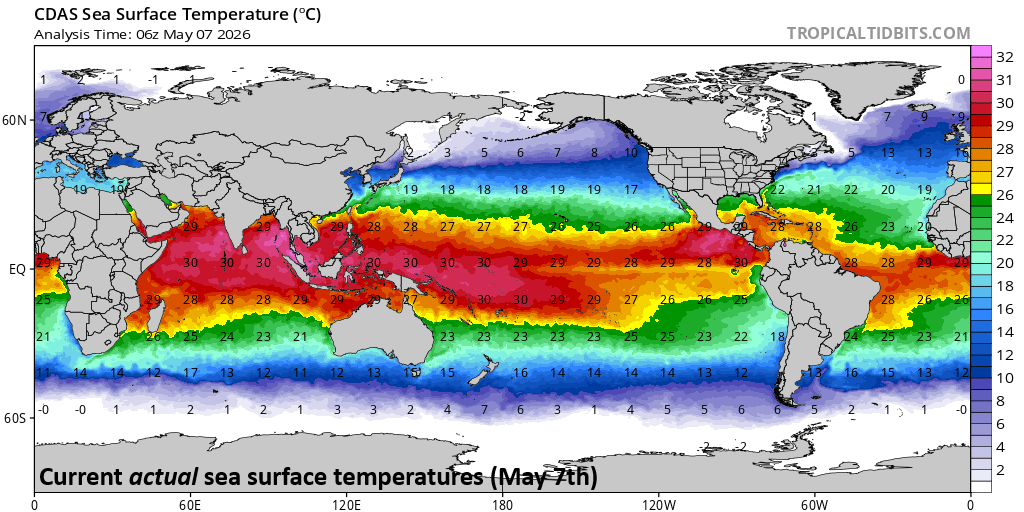
Current sea surface temperatures in the tropical Pacific feature the warmest water across western sections of the world’s largest ocean…when westerly winds develop, this warm water will push to the east, initiating El Nino conditions. Map courtesy NOAA, tropicaltidbits.com
When these trade winds, which normally blow from east to west, weaken or reverse, it allows warm water that is usually piled up in the western Pacific to migrate eastward toward South America, initiating El Nino. In addition, the weakening of the easterly trade winds reduces or stops the normal “upwelling” of cold, nutrient-rich water along the coast of South America, resulting in warmer sea surface temperatures.
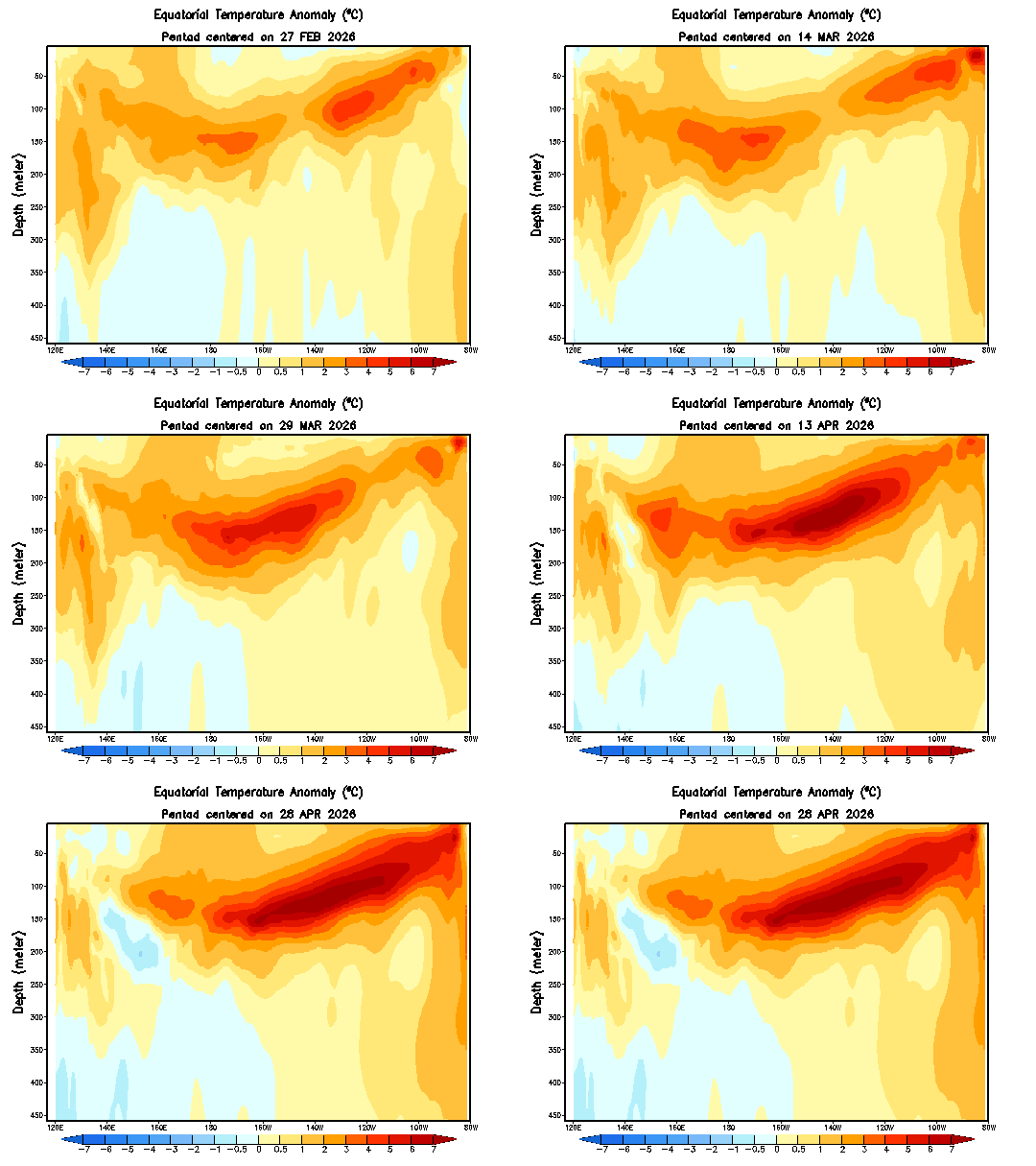
Sub-surface water temperature anomalies (°C) down to a depth of 450 meters are shown here from the equatorial part of the Pacific Ocean in the period from 27 February 2026 to 28 April 2026. Much warmer-than-normal water (shown in orange) is now lurking just beneath the surface (top of map) across much of the tropical Pacific and the cold water (shown in blue) at and just below the surface level has tended to shrink in extent in recent days. Map courtesy NOAA/CPC, International Research Institute [Note – “Nino 3.4” region is 120°W-170°W.]
The bottom line is that a sustained “negative” reading of the SOI is usually correlated quite well with development or intensification of El Nino conditions in the tropical Pacific and recent values suggest water temperatures will continue to rise incoming days. Finally, further support for an increasingly strong El Nino event comes from computer forecast models which almost universally predict water temperatures to reach well above neutral levels in time for the summer and fall tropical season in the Atlantic Basin….perhaps peaking at the end of 2026 or beginning of 2027.
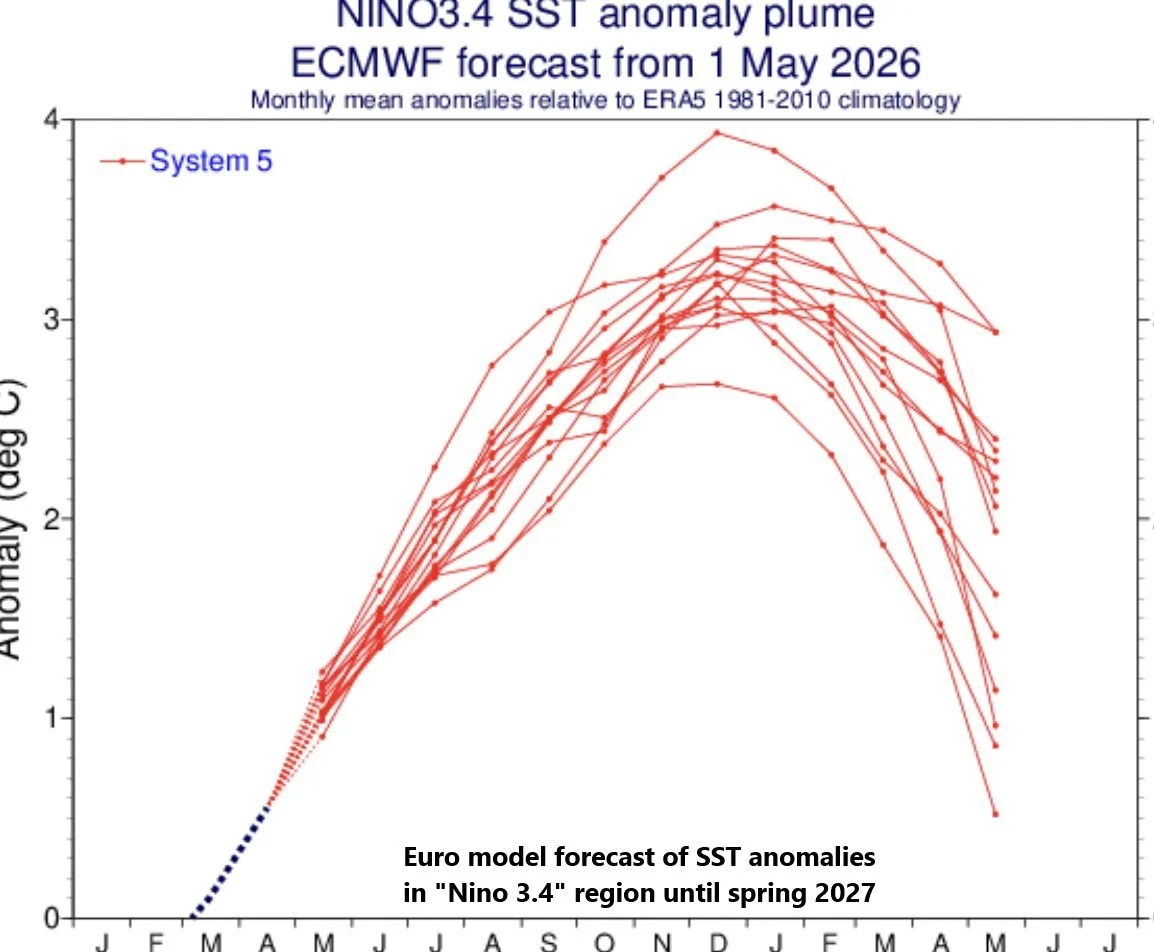
The most recent run of the Euro model features very strong El Nino conditions in the central Pacific region known as “3.4” that may continue at some level all the way into the spring of 2027. This model forecast indicates the El Nino conditions may peak around December of this year or in January of 2027 - potentially having a big impact on next winter across the continental US. Plot courtesy ECMWF, Weather Bell Analytics (Meteorologist Joe Bastardi, X)
Potential impact on the 2026-2027 winter season
Signs point to a continuation of El Nino conditions as we head into the early part of 2027 which means there can be a big impact on next winter across the continental US. However, it is a too early to have a handle on its magnitude this far ahead and another metric that will need to be determined in coming months is where the most warming will take place relative-to-normal. An “east-based” El Nino with the warmest water relative-to-normal sitting just off the west coast of South America could overwhelm the US with mild Pacific air for next winter. However, a “central-based” event would open the door for some troughiness in the eastern US (and potentially some colder air compared to the “east=based” case)...just too early to say. An interesting note, the average of those three strong El Nino events in recent history (i.e., 1982-1983, 1997-1998, 2015-2016) produced much warmer-than-normal conditions in much of the country with the exception being the southwest US.
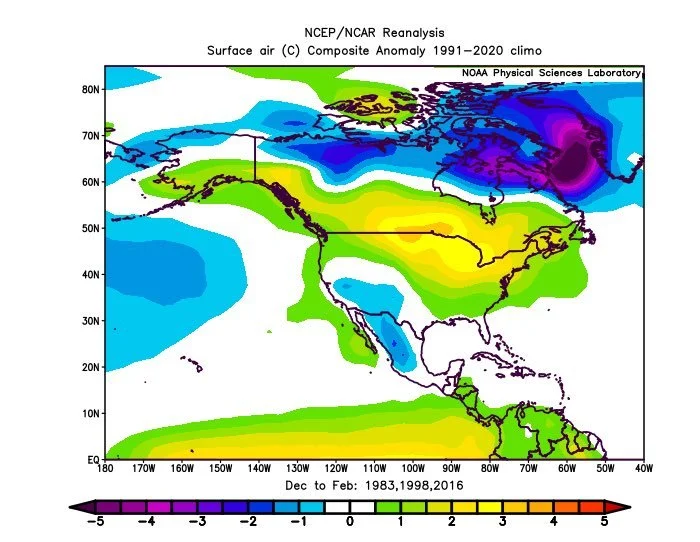
With the exception of the SW US, warmer-than-normal weather dominated the winter seasons across much of the nation during the strong El Nino events of 1982-1983, 1997-1998, and 2015-2016. Map courtesy NOAA
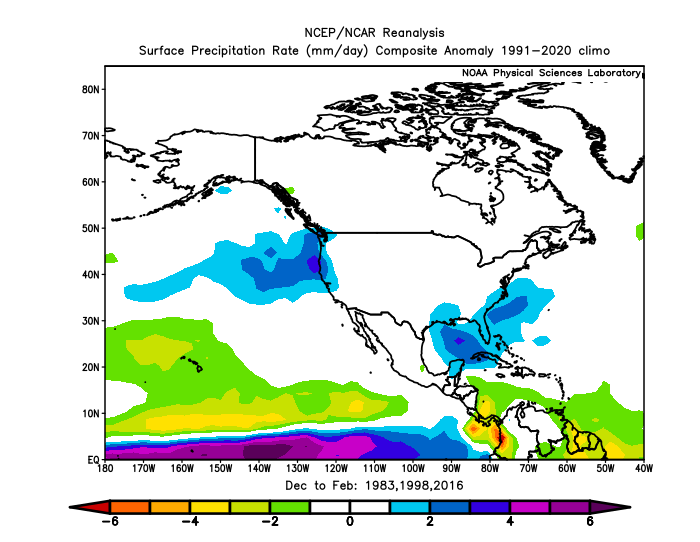
In terms of precipitation, wetter-than-normal conditions took place during the strong El Nino events of 1982-1983, 1997-1998, and 2015-2016 across portions of the SE US and NW US and nearly normal elsewhere. Map courtesy NOAA
Historical context
As mentioned above, there have been three very strong El Nino events during the last 50 years with the most recent taking place in 2015-2016 and two prior in 1982-1983 and 1997-1998. El Nino and La Nina are the warm and cool phases of a natural climate pattern across the tropical Pacific known as the El Nino-Southern Oscillation or “ENSO” and we have evidence of this phenomenon going back hundreds of years using tree rings, rainfall and drought records. In fact, the El Nino event of 1877-1878 is often referred to as a “Mega or Super” event; especially impactful as it was in an era coming on the back end of the “Little Ice Age” and the preceding three years featured La Nina. It caused widespread drought, monsoon failure, and catastrophic famines across Asia, Africa, and South America, resulting in 19 to 50 million deaths.
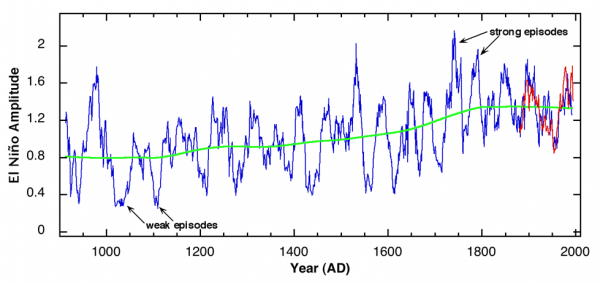
Using tree rings, rainfall and drought records, a reconstruction of El Nino events can be performed with some level of confidence going back hundreds of years. Some of the strongest El Nino events are believed to have taken place in the 17th and 18th centuries. (Source)
Before that, evidence points to extremely severe multi-year El Nino events during the periods of 1685-1688 and 1789-1793. It is believed that these particular El Nino episodes were probably even stronger than the cataclysmic El Nino episode of 1877-1878, and much stronger than the most recent noteworthy events of 1997-1998 and 2015-2016. (Credit to Meteorologist Dr. Ryan Maue for some of the historical information presented here).
Meteorologist Paul Dorian
Arcfield
arcfieldweather.com
Video discussion: