*"Just a bit outside"...thankfully...a close call with asteroid Apophis in April 2029 and billions should be able to view it*
Paul Dorian
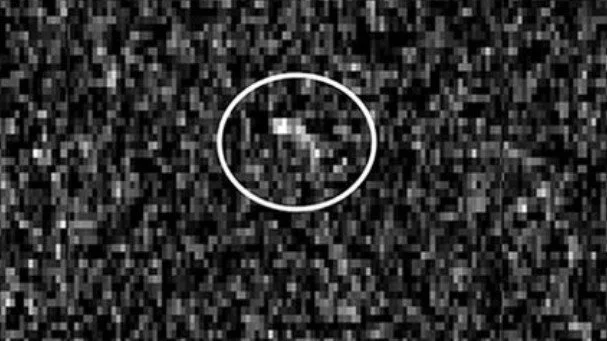
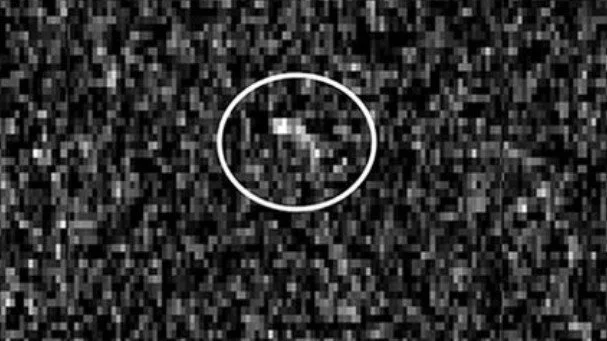
These images of asteroid Apophis were recorded in March 2021 by radio antennas at the Deep Space Network’s Goldstone complex in California and the Green Bank Telescope in West Virginia. The asteroid was 10.6 million miles (17 million kilometers) away from Earth. Credit: NASA/JPL-Caltech and NSF/AUI/GBO
Overview
It was quite a scare when first discovered in 2004, but thousands of observations later, we now know that the asteroid known as Apophis will miss Earth when it makes its closest approach in April 2029. However, in the grand scheme of things in our vast universe, this will be a close call, and it’ll come so close that billions of people should be able to see it with their naked eyes. Interestingly, the closest flyby to Earth by Apophis will fall on “Friday the 13th” in April of 2029.
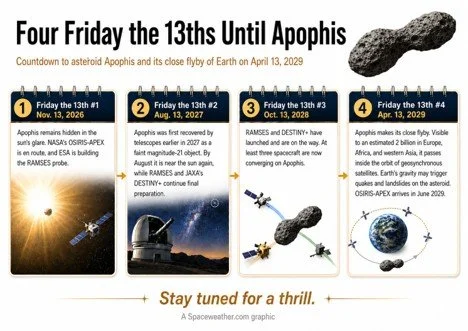
Credit spaceweather.com
Discussion
The asteroid that is officially known as 99942 Apophis - named after the Egyptian god of chaos and darkness - will safely fly past Earth on Friday, April 13th, 2029, but the earliest calculations gave it a 1-in-37 chance of hitting Earth or a 2.7% probability...the highest impact odds ever given to a sizeable asteroid. Years after the initial discovery in 2004 and thousands of observations later, we now know that Apophis will miss, but by so little that billions of people should be able to see it with their naked eyes according to spaceweather.com. In fact, there are estimates that as many as 7.6 billion people on Earth will be able to see asteroid Apophis with their naked eyes - about 90% of the world’s population - with North America being the only continent that will not get a clear view of Apophis. (Source). During the flyby, Apophis will move around 42 degrees per hour (the width of a full Moon every minute according to spaceweather.com) and will visibly drift against the background stars...a sight no human has ever seen without a telescope. Since 2021, telescopes on Earth have been unable to see Apophis as it has been hiding in the sun’s glare. However, by August of 2027, the asteroid should re-appear to Earth’s telescopes as a faint magnitude 21 speck.
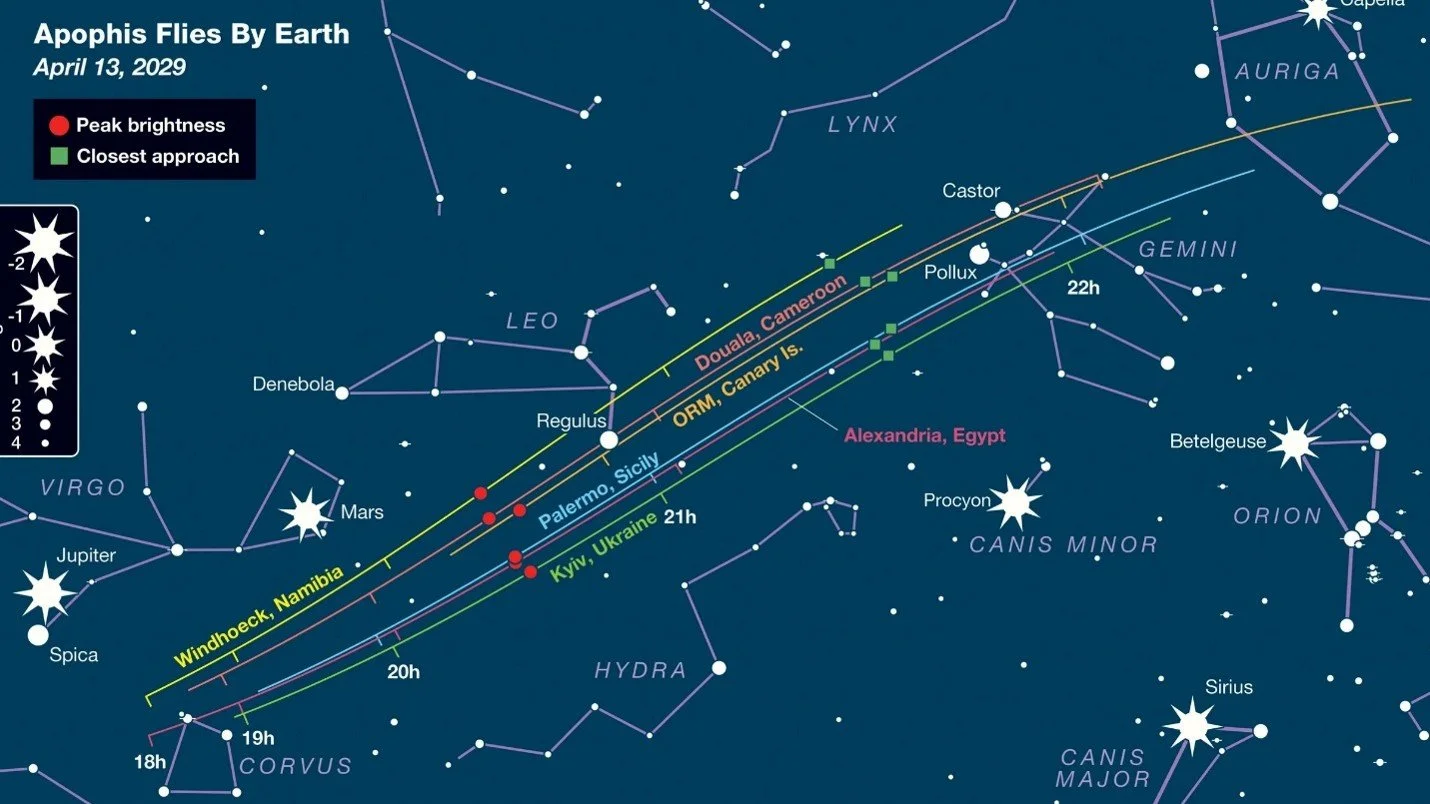
Apophis will slowly move across the night sky through a set of well-known constellations, although its exact position will depend on where in the world you are. (Image credit: eclipseatlas.com)
Apophis is a peanut-shaped ~375-meter near-Earth asteroid and will pass within 20,000 miles of Earth’s surface (Source). While that is much farther away than the International Space Station and the thousands of other spacecraft in low Earth orbit, it is closer than several hundred satellites stationed in an elevated geosynchronous orbit. (Apophis poses no threat to these high-altitude satellites because they can easily be maneuvered away from its projected path.)
Because Apophis is coming so close, it presents a once-in-a-lifetime opportunity for scientific study. Earth's gravity will slightly alter the asteroid's orbit and potentially cause physical shifts like quakes on the space rock's surface. [1, 2, 3, 4, 5]. Several space agencies are preparing missions to intercept and study the asteroid during this rare flyby:
OSIRIS-APEX (NASA): Originally the OSIRIS-REx spacecraft that visited the asteroid Bennu, this probe has been redirected to intercept Apophis and study its surface changes and composition. (Source)
RAMSES (ESA): The European Space Agency is sending a mission to rendezvous with Apophis as it passes by, deploying smaller companion spacecraft to record how the asteroid reacts to Earth's gravity. Cruising alongside the asteroid, Ramses will release two CubeSats and one will try to land. (Source)
Japan's DESTINY+ spacecraft, developed by Japan’s Aerospace Exploration Agency (JAXA), is a deep space technology demonstrator mission that will perform a preliminary flyby of the near-Earth asteroid Apophis. Launching in 2028 aboard Japan's new H3 rocket, the probe will gather crucial data on cosmic dust and the asteroid's surface as it continues in route to its primary target, the active asteroid 3200 Phaethon. (Source)
One final note, if such an asteroid were to strike the planet, the consequences would very likely be catastrophic. The energy released would be equivalent to more than 1,000 megatons of TNT, which is significantly more powerful than the 1908 Tunguska event (presumably a meteorite or comet) that devastated a large part of eastern Siberia more than a century ago. An impact would destroy areas for hundreds of kilometers and could trigger massive tsunamis if it hit the ocean. (Source) Not to worry though as NASA has definitively confirmed that Apophis poses zero risk of impacting Earth for at least the next 100 years. (Source)
Meteorologist Paul Dorian
Arcfield
arcfieldweather.com