
**An impressive cold air mass with its origins over the Arctic reaches the eastern states early next week...snow on the table Great Lakes/interior NE US/New England**
Paul Dorian

An impressive cold air mass with its origins over the Arctic region reaches the eastern states early next week with temperatures potentially some twenty degrees below normal for this time of year. Map courtesy ECMWF, Weather Bell Analytics
Overview
There will be as many as three cold fronts to deal with in the northeastern part of the nation during the next week or so, but the third system will be the most important and is destined to arrive late in the upcoming weekend. The first cold front comes through on Wednesday night primarily on the dry side and it turns slightly cooler behind it on Thursday. The second cold front then arrives at the end of the work week likely producing some shower activity from late Friday night into early Saturday; however, temperatures will hardly change at all this weekend following its passage. It is the third cold front that arrives on Sunday night that will be very noticeable as it is at the leading edge of an Arctic air mass…the coldest air so far this season. This cold air outbreak early next week may be accompanied by some early season accumulating snow across the Great Lakes, interior sections of the Northeast US and New England.
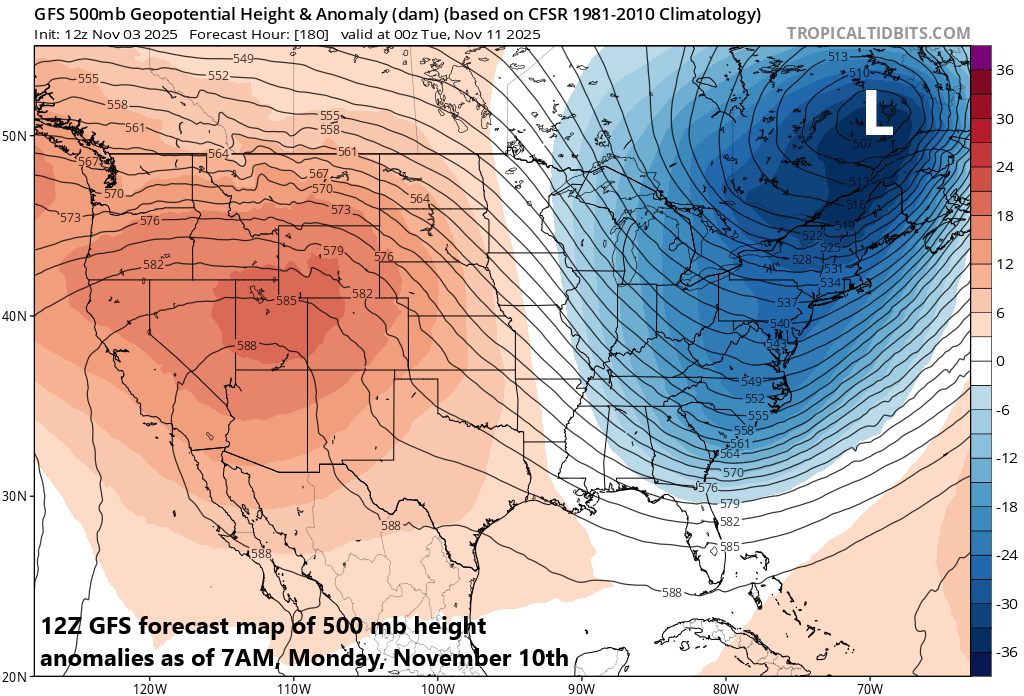
A deep upper-level trough of low pressure will develop over the southeastern part of Canada by early next week associated with an early season Arctic blast. At the same time, strong ridging will pop up across the western part of the nation. Map courtesy NOAA, tropicaltidbits.com
Details
After a cool, dry day on Tuesday in the Mid-Atlantic region, it’ll turn a bit milder at mid-week ahead of the next cold frontal system. This front comes through on Wednesday night – likely on the dry side – and it’ll be followed by breezy and slightly cooler conditions on Thursday. Another cold front will approach the Mid-Atlantic region late on Friday and it can produce some shower activity from late Friday night into Saturday morning across the northeastern part of the country. The temperature change behind this late week cold frontal system will be pretty much non-existent and high temperatures on both weekend days should be 60+ degrees in much of the DC-to-Philly-to-NYC corridor.

Low pressure may accompany the strong cold frontal system late in the upcoming weekend and accumulating snow is on the table for the Great Lakes, interior Northeast US and New England. Map courtesy NOAA, tropicaltidbits.com
By Sunday, a third in a series of cold fronts will be headed southeast across the Great Lakes and likely to arrive in the northeastern states by early Sunday evening. This cold frontal system will be accompanied by low pressure that likely moves in a northeastward direction from the eastern Great Lakes to the southeastern part of Canada. This cold front will be at the leading edge of an Arctic air mass…the coldest air of the season so far with temperatures as much as twenty degrees below normal for this time of year on Monday and Tuesday. The low pressure system that rides along the frontal boundary zone can produce some accumulating snow by early next week across the Great Lakes, interior sections of the Northeast US, and New England. Depending on movement of an upper-level low, there is also a chance for some snow across portions of the Appalachian Mountain range in the Tennessee Valley region.
Stay tuned…the first taste of winter is on its way in the eastern US for the early part of next week.
Meteorologist Paul Dorian
Arcfield
arcfieldweather.com
Follow us on Facebook, Twitter, YouTube
Video discussion: